The Author and Judith Take Psilocybe azurescens
How to Change Your MindThe Author and Judith Take Psilocybe azurescens describes an afternoon when a small quantity of mushrooms gathered by the author and Paul Stamets led not to a single shared revelation but to sharply different experiences. Judith initially felt frightened and disoriented; the author, after remaining alert to her needs, encountered a garden that seemed newly alive with the presence of other beings. The episode became a test of how he understood nature: as scenery observed from outside, or as a community of lives in which human perception and feeling are implicated.
The Tea and the Walk Home
Many months after the mushrooms were found at the edge of a parking lot in a state park on the Pacific coast, the author and Judith ate them during a summer week at their former home in New England. He crumbled two small mushrooms into each of two glasses and poured hot water over them, following Stamets’s recommendation to cook the mushrooms to destroy compounds that could upset the stomach. They each drank half a cup, including both the tea and the mushroom pieces, then set out along a dirt road while they waited for the effects.
Within about twenty minutes, Judith said she was feeling unpleasant effects. She no longer wanted to be walking, though they were at least a mile from home. She described her mind and body as drifting apart, and her mind as having flown out of her head and into the trees like a bird or insect. She urgently wanted to get home and feel safe, and did not want to meet anyone. The author tried to reassure her as they turned back and hurried along the hot, humid road. He still felt mostly like himself, but suspected that her distress was keeping him from feeling the mushrooms: someone needed to be capable of behaving normally if a neighbor stopped to talk.
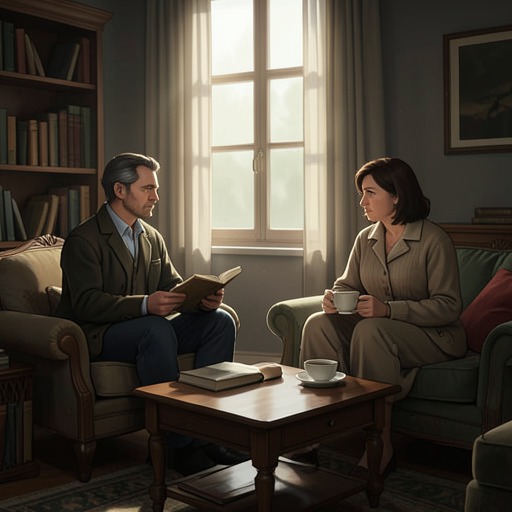
Near home, a neighbor’s pickup truck came toward them. The two ducked into the woods until it passed, like guilty children. Judith went straight to the living-room couch, drew the shades, and lay down. The author, not yet feeling much, finished his cup of tea in the kitchen. Once Judith had reached the couch, she felt better. Her response to the experience had shifted: she later described the coffee-table stains coming alive, swirling and transforming, and wanted to be left alone with the images. As a painter, she was drawn further into them; the author recognized that they would spend the afternoon in what he called parallel play, near one another but absorbed in different experiences.
The Garden Comes into Focus
Outside on the screened porch, the author found the garden’s ordinary sounds suddenly overwhelming. Insects and hummingbirds formed a cacophony that grated on him until he changed his attitude toward it and was able to hear it as beautiful. With his eyes closed, he saw fractal patterns, tunnels through foliage, and grids of ropy vines. When the images began to make him panic, opening his eyes restored a measure of normality; closing and opening them felt like changing channels. The episode was not simply an uncontrolled visual journey: he found a way to manage it.
He decided to walk to the small writing house he had built twenty-five years earlier. It held memories of another life and of the two and a half books he had written there, at a window overlooking the pond, garden, and house. Before going far, he checked on Judith. She was stretched out on the couch with a cool, damp cloth over her eyes and said she was fine. Then he crossed the garden on unsteady, rubbery legs. Dragonflies traced patterns overhead; plume-poppy seed heads rattled as he brushed past; phlox scented the air, which felt so dense it had to be forded.
The garden’s intensity was inseparable from its history. The house and grounds belonged to years the couple had spent there first together and then as a family, but they no longer lived there. The author felt that a precious memory had not merely returned to mind but had come back to life, beautiful and painful at once. Late-August abundance sharpened the sense of loss: the plants’ bloom and fragrance seemed especially precious because an imminent killing frost would end them. He felt emotionally exposed, without his usual defenses.
A View Through the Leaves
The writing house itself seemed abandoned. Its shelves had been emptied, and the author lay on a daybed he had rarely taken time to use while working there. Across the window, an arbor was densely woven with the climbing hydrangea he had planted decades earlier. Its round leaves filled the view, lit from behind by the late-afternoon sun. He saw the world through their green screen and experienced the leaves not as passive objects but as a vantage point: sunlight entered them and was transformed into new matter. The plant seemed to look back at him with curiosity and benevolence.
That impression was powerful, but the author did not present it as an unambiguous supernatural encounter. He knew how implausible the experience might sound, and retained what he understood as an observing self; it was not, in the researchers’ terms, a complete mystical experience. Still, the distinction between matter and spirit seemed to lose its force. Looking through the hydrangea toward a swamp maple in the meadow, he found the tree newly vivid and benevolent, while the boundary that ordinarily separated him from the world seemed to soften. Ideas he had previously considered in writing—about the subjectivity of other species and their capacity to act upon human beings—had acquired the immediacy of feeling.
Becoming Part of the Scene
On the walk back, which he remembered as the experience’s peak, the air again seemed thick with scent and life. Dragonflies were so numerous that he was unsure whether he could trust his sight; Judith later confirmed that she had seen them too. As they crossed the garden, the insects’ flight left apparent trails in the air. Dusk brought the pollinators’ final rounds and the flowers’ continuing display. The author recognized the familiar return of activity after a hot day, but now felt integral to it rather than positioned outside it as an observer. The flowers’ display seemed directed not only toward the pollinators but toward him as well; he felt like one being among many, in relation to the whole.
The experience recalled Alexander von Humboldt’s proposition that everything acts and reacts in relation to everything else, and made the author feel, unusually, that he was identical with nature. Its consequence did not end with the afternoon. He later described an opening of the heart toward his parents, Judith, and even the plants, trees, birds, and insects on the property; some of that openness persisted. He remembered the experience as one of wonder and immanence, while remaining uncertain about what it meant.
Meaning and Uncertainty
The author explicitly considered two readings of what had happened. On a materialist account, psilocin had acted on 5-hydroxytryptamine 2-A receptors, producing disordered mental activity in which thought and feeling became entangled with visual perception. The alternative was not proof of a supernatural world, but the possibility that the experience had disclosed something about the personhood of other beings and the author’s ordinary separation from them. The mushroom’s smallness and humble origin could be seen either as another wonder or as a reason to favor the physiological explanation.
Before the afternoon, he had assumed that access to a spiritual dimension depended on belief in God or a beyond. Afterwards, he entertained the possibility that wonder in a garden might instead recover a perspective obscured by habitual mental filters. He concluded that the experience demonstrated, at minimum, that unfamiliar forms of consciousness were available to him, without settling what they signified. Its ending was therefore not certainty but renewed openness: he was ready to reconsider what counted as reality.